Quick review: shunts and Eisenmenger syndrome

I’ve had a few students ask about the quiz question on the ductus arteriosus – and that probably means that there are other students that could use a quick review.

Here’s the quiz question, with the correct answer marked.
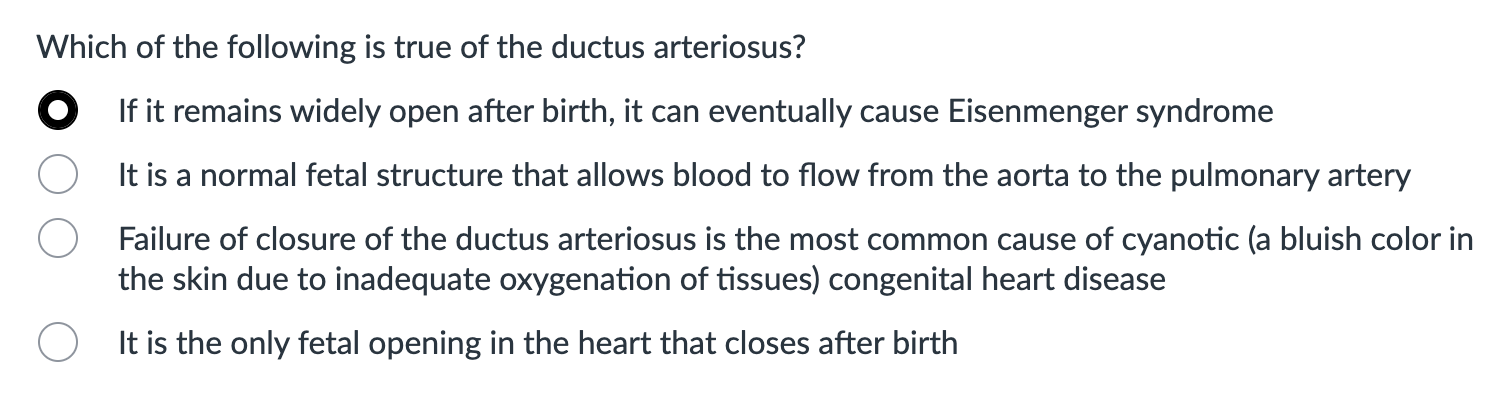
I think some people thought that Eisenmenger syndrome ONLY happened in atrial septal defect – and that was the underlying problem with trying to pick the right answer.

So let’s review a few concepts we talked about in lecture just to make sure everyone is clear on what shunts are, and what Eisenmenger syndrome is.

Shunts

Left-to-right shunt. When you have an atrial septal defect, or a ventricular septal defect, or a patent ductus arteriosus (and you’re out of the womb!) blood is going to pass (shunt) through any of those three holes/connections from the higher-pressure left side of the heart to the lower pressure right side of the heart (or great vessels). This is called a left-to-right shunt. It’s what you’d expect if you have a hole somewhere: blood’s going to move from the higher-pressure side to the lower-pressure side.

Right to left shunt. If this left-to-right shunt is large, and it doesn’t get surgically corrected, a weird thing can happen: the shunt can reverse directions. All that extra blood being shunted into the right side of the heart makes that side work harder than it normally would. This isn’t great for the lungs, because they’re delicate, and they are used to getting low-pressure blood flow pouring into them.

Now you have a big bulky right side of the heart, and it forces blood out into the pulmonary vasculature at a higher pressure. The lungs don’t like this, so they try to compensate by constricting arterioles to protect the delicate capillary beds surrounding the alveoli. And that means that now the right side has to work even harder to pump blood through the now-constricted lung vessels. Aaand that means the vessels fight back even more, maybe by making some fibrous tissue. Yikes.

Eisenmenger syndrome

Eisenmenger syndrome is a term used to describe this reversal of shunting (from left-to-right to right-to-left). It can happen in many defects (the ones we talked about were ASD, VSD, and PDA). It’s important to know about, because If this syndrome happens, you really need to get whatever heart defect is present repaired. If you do that soon enough, it will prevent irreversible lung damage.

Quiz 1 is now up!

I just posted quiz 1 on Canvas. It covers all three lectures we’ve had so far (Blood Vessels, Heart 1 and Heart 2). There are 10 points, you have 30 minutes once you start, and it’s open-book, open-note, open-talking-with-each other – so I hope it’s not anxiety provoking. It will be open until 11:59 on Tuesday (since the lectures didn’t get posted until today).

I just like to give you a few more chances besides exams to accrue points and help keep you on top of the material between exams. I’d rather have these quizzes in the classroom because then I get to see you and talk about whatever seems unclear – but for this quiz, this will have to do!

There’s no honorlock or anything so you should be able to just login and take it without a problem. 

Any questions or problems, let me know.

Updates to the website

I updated the following on our website today:

  • New versions of our Blood Vessels, Heart I, and Heart II ppts and slides (all on our schedule page). All I did was update the lecture titles (to make them consistent with each other) and add objectives to each lecture.
  • I added two new posts: one about a very cool atherosclerosis website, and another with some optional study resources (posts from my Pathology Student website) about blood vessel and heart pathology.
  • I reviewed and updated the Cardiovascular Kahoot (on our Kahoots page).
  • I added in Quiz 3; it is on December 7 at 10:10 am (it’s on our schedule page now).

Short cardiac pathology posts that may help you

I’ve mentioned my PathologyStudent.com website to you guys – it’s a website I created to make pathology less confusing. Feel free to peruse it (or not) as you see fit (it’s just an optional resource – and you may not need it, which is fine). A lot of the posts actually came from questions Dental Students asked me – so you might find something useful.

From time to time I’ll share some Pathology Student posts here, just in case you find them useful.

Here are some that relate directly to the blood vessel and heart stuff we’re covering in class now.

Remember – this is completely optional reading – use it only if it seems useful to you.

Very cool website about atherosclerosis

This is the official website for the Multi-Ethnic Study of atherosclerosis (MESA), a huge study that has been following over 6,000 patients of different ethnicities since 2000! One of the really interesting parts of this study is that it is studying people WITHOUT symptoms of underlying atherosclerosis (in other words, they haven’t had any chest pain or heart attacks or strokes). Thank you very much to the student who drew my attention to this!!!

Why would you want to study people without symptoms? Because atherosclerosis is silent until it presents with nasty stuff like heart attacks, sudden death, stroke, etc. Maybe the researchers will find some characteristics that have been previously unidentified! And maybe they will find some new risk factors that have not been identified either!

There are some cool tools on the website, including one that calculates your likelihood of having a coronary heart disease event within the next 10 years! I was happy to find out that mine is very low (yay!).