I’ve had a few students ask about the quiz question on the ductus arteriosus – and that probably means that there are other students that could use a quick review.
Here’s the quiz question, with the correct answer marked.
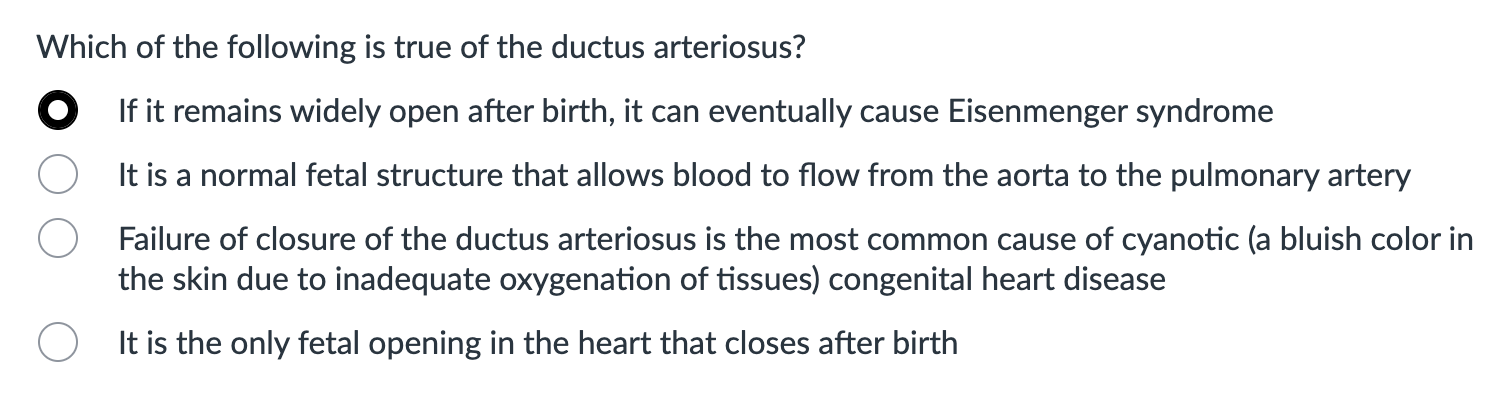
I think some people thought that Eisenmenger syndrome ONLY happened in atrial septal defect – and that was the underlying problem with trying to pick the right answer.
So let’s review a few concepts we talked about in lecture just to make sure everyone is clear on what shunts are, and what Eisenmenger syndrome is.
Shunts
Left-to-right shunt. When you have an atrial septal defect, or a ventricular septal defect, or a patent ductus arteriosus (and you’re out of the womb!) blood is going to pass (shunt) through any of those three holes/connections from the higher-pressure left side of the heart to the lower pressure right side of the heart (or great vessels). This is called a left-to-right shunt. It’s what you’d expect if you have a hole somewhere: blood’s going to move from the higher-pressure side to the lower-pressure side.
Right to left shunt. If this left-to-right shunt is large, and it doesn’t get surgically corrected, a weird thing can happen: the shunt can reverse directions. All that extra blood being shunted into the right side of the heart makes that side work harder than it normally would. This isn’t great for the lungs, because they’re delicate, and they are used to getting low-pressure blood flow pouring into them.
Now you have a big bulky right side of the heart, and it forces blood out into the pulmonary vasculature at a higher pressure. The lungs don’t like this, so they try to compensate by constricting arterioles to protect the delicate capillary beds surrounding the alveoli. And that means that now the right side has to work even harder to pump blood through the now-constricted lung vessels. Aaand that means the vessels fight back even more, maybe by making some fibrous tissue. Yikes.
Eisenmenger syndrome
Eisenmenger syndrome is a term used to describe this reversal of shunting (from left-to-right to right-to-left). It can happen in many defects (the ones we talked about were ASD, VSD, and PDA). It’s important to know about, because If this syndrome happens, you really need to get whatever heart defect is present repaired. If you do that soon enough, it will prevent irreversible lung damage.


Pingback: Path Exam 1 details | Dental Student Pathology